

The truth behind McConnell's absence
And the "impossible spot" Andy Beshear finds himself in


Today you’re getting a bit of a crossover special: think “That’s So Sweet Life of Hannah Montana.”
There is so much insightful, incisive writing out there that I believe you deserve to see. So, while I let my brain recharge in the 250V Europlug outlet in my hotel room, it makes perfect sense to put this repost in front of you.
Steve Morris is not only my longest-term collaborator — from the inception of “WTF America” to its final resting place (RIP) — he is my favorite one, too. He remains at the helm of “Margin of Error,” which you can (and should) find on The Recount’s YouTube.
But today, I’m introducing you to his fantastic newsletter “The Long Run,” covering Democratic governance, governors, and the fight for the future of the Democratic Party. In his words:
“The fight for the Democratic Party's future is the most interesting and important story in politics right now. My weekly newsletter, The Long Run, covers every angle of that story — from state policy decisions to 2026 campaigns to 2028 moves.”
Don’t fret, you get a little Grace in the piece below … hence the crossover episode. Give it a read, become a subscriber, and let us know what you think in the comments!

Where’s Mitch McConnell?
It’s a question that has echoed through the liberal world over the past month, chanted by everyone from Democratic activists to famous drag queens. It’s also a question that has presented a unique challenge for Kentucky Gov. Andy Beshear.
For those who have the good fortune not to spend time in the booming world of conspiracy-tinged political commentary, a recap:
1. Sen. Mitch McConnell has had worsening health problems in recent years. He was hospitalized in June and has not made public appearances for nearly two months, which became the genesis of speculation that McConnell is either incapacitated or, in some telling, already dead.
2. States are free to decide individually how to fill vacancies in the Senate. While most allow for an appointment by the governor, Kentucky is one of five that require a special election, after Republicans in the legislature changed the law in 2024. That move, while partisan and aggressive, is not unique: the legislatures of deep red and deep blue states have frequently passed similar laws when members of the opposing party have won the governorships. One example: Massachusetts Democrats changed their state law while Mitt Romney was governor, setting in motion the events that would make Scott Brown a senator.
3. What is different in Kentucky: a provision of the state Constitution requiring that “vacancies in all offices for the State at large... shall be filled by appointment of the Governor.” It remains unclear if that provision includes federal positions, like senator, or merely applies to state officers like Attorney General or Secretary of State.
In the eyes of many, Beshear, who leads by far the reddest state of any Democratic governor, has been asleep at the wheel as McConnell’s absence has grown more suspicious. To those in this camp, Beshear should have unilaterally declared the seat vacant — even while McConnell lived — while also declaring the state law unconstitutional, so as to fill the seat with a Democratic senator. I’ll let you go elsewhere for a full breakdown of the problems with this argument but, put generously, it has exceedingly little merit.
To begin with, there is no indication McConnell is actually dead, which is in fact a prerequisite for filling his seat. Senate Democrats also continue to benefit from his absence — Todd Blanche’s narrow confirmation as Attorney General was only in doubt because McConnell was gone, and he would have been confirmed even if Beshear had already appointed a Democrat. For now, the party has every bit of advantage they can get out of the situation.
What’s most interesting about the episode, in my view, is what it says about the modern Democratic information ecosystem. In recent weeks, the fury with Beshear online has boiled over. Notably, liberal content creators have led the way, using platforms that collectively reach millions to blast the governor in increasingly harsh terms.
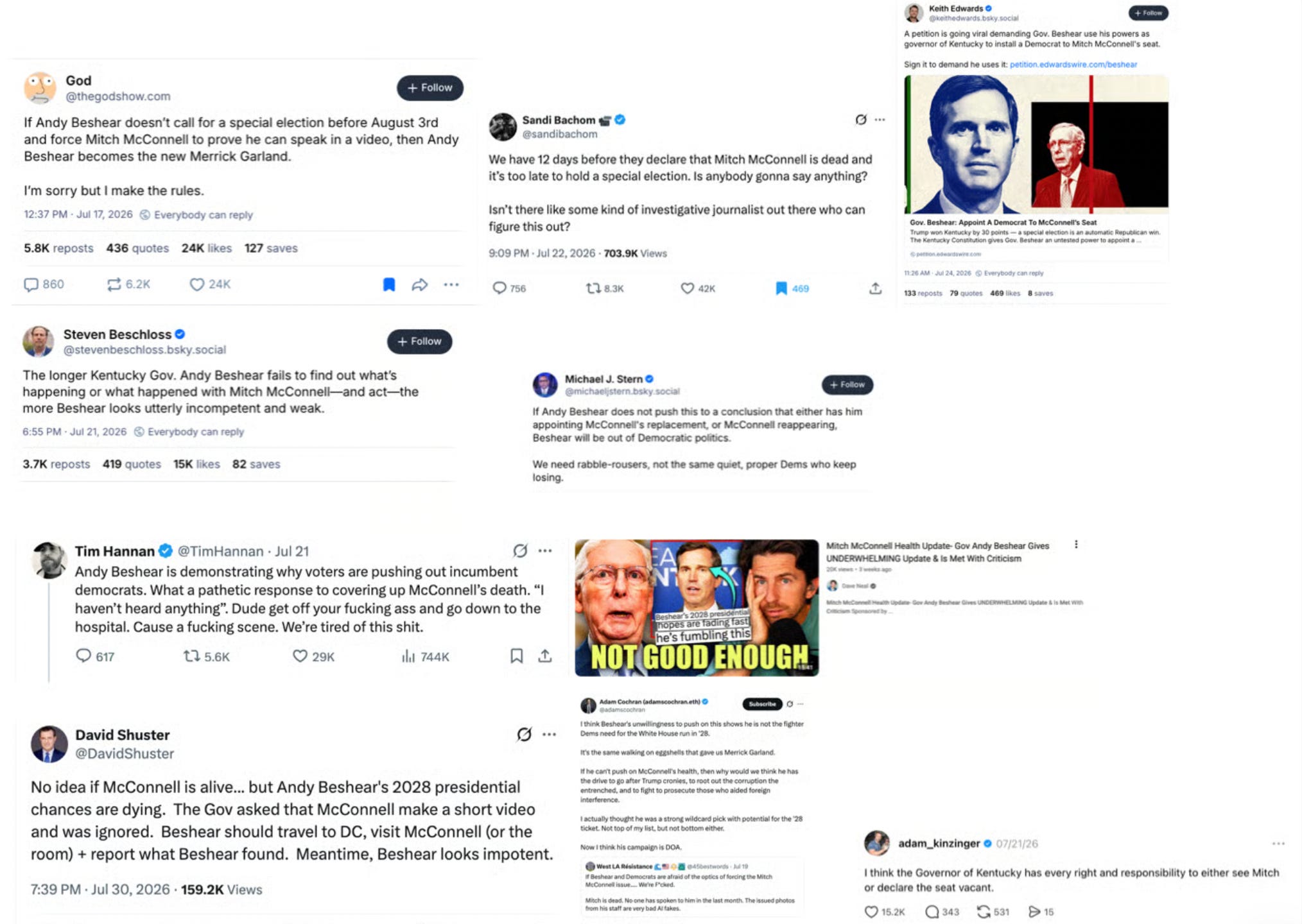
That’s caused some schadenfreude on the right: former McConnell adviser Scott Jennings said on CNN this week that the criticism “amuses quite a few of us in McConnell-world.” To those in Beshearworld, it’s not funny at all.
A new landscape
I’ve found myself fascinated by the outcry online and what it says about the broader landscape on the left right now. I reached out to my old friend Grace Weinstein (that’s me!), who chronicles the growth of creator journalism in her newsletter Who Broke It. She sees two things at play:
“First and foremost: Mitch McConnell is one of the most recognizable faces and figures in modern politics. People who know nothing about our government at any level know who Mitch McConnell is. His reputation preceded him and his persona transcended politics without he, himself, ever making a foray into pop culture. He is the last dinosaur standing from a bygone era — one that a lot of young people never knew, don’t mourn, and won’t admit they’d probably prefer to our current one. We understate how much joy our culture gets out of watching a former apex predator be reduced to simple internet prey. Memeing someone’s downfall is as American of a past-time as baseball, especially if it’s someone a lot of people call evil. And in a world of Instagram story statements and Notes App apologies, radio silence creates a void young people are more than happy to fill with our signature twisted imagination and dark sense of humor.
“What underlies the fun and games is the second, more powerful thing: rage. People are enraged over the idea that Mitch McConnell can disappear without explanation, leaving constituents unrepresented in the Senate. Who comes to mind? The Democratic governor — he’s the peak of power in the state, surely he can fix it! There’s a level of desperation among people who feel powerless that leads them to hold the wrong person accountable out of a desire to see anyone held accountable at all. They’re putting Andy Beshear, a member of their own party and someone they’re lucky has power in Kentucky at all, in an impossible spot: Either ignore the demands of liberals on the internet (generates more rage) or concoct some bizarre stunt to satisfy their demands on paper (likely a waste of a sitting-governor’s time). Have fun with that one!”
I think the two points — McConnell’s ubiquity and Democrats’ sense of powerlessness — are dead-on. I’d add a third: algorithm-driven liberal content creators have increasing sway among the Democratic grassroots, and a message of ineffectual establishment has been too good for many to pass up.
What’s notable about Beshear: his team has worked directly to tamp down the criticism. “There’s a very palpable frustration out there that we totally understand,” a senior adviser to Beshear told me. “That said, there have been some folks demanding the governor do things that he just cannot legally do.” Asked directly if the governor’s team had reached out to journalists and content creators criticizing the governor, the aide said that there have been “conversations” with journalists and content creators but declined to go further.
A second source in Beshear’s orbit confirmed there had been proactive outreach, including to content creators outside of traditional newsrooms. One liberal content creator who has covered the issue and requested anonymity said they had not had any conversations with the governor’s aides but said they knew directly of a colleague who had received reprisal from an operative.
It’s all seemingly been enough to push Beshear towards a more pugnacious tone online recently. He missed last weekend’s Fancy Farm, an annual bipartisan Kentucky political gathering, for a family obligation but weighed in with some zingers online.
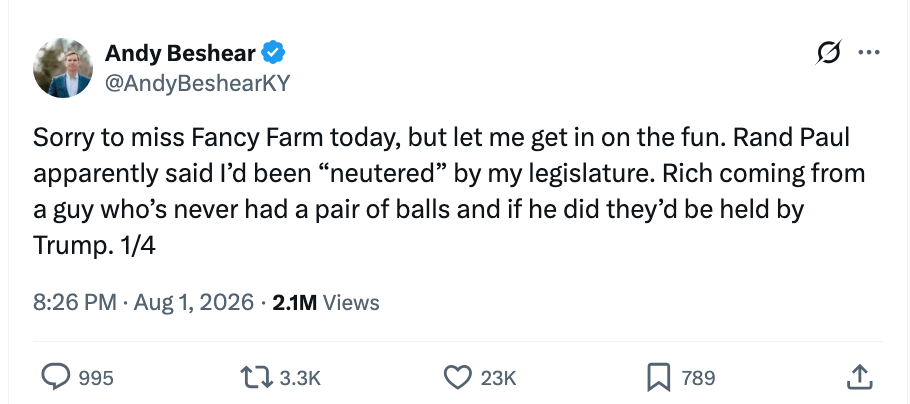
The Beshear adviser argued the post had more to do with the nature of Fancy Farm, where trash talk is prized, but was quick to tout the governor’s strength. “You do not win three statewide elections in a Trump +31 state if you’re not a knife fighter,” they said. “And he is tough as nails.”
Knife fighter or not, the whole saga underscores a new challenge for Democrats, one that foreshadows what will likely be a key dynamic in the 2028 primary: once deferential to the point of fault, elements of the party base are now suspicious to the point of paranoia.
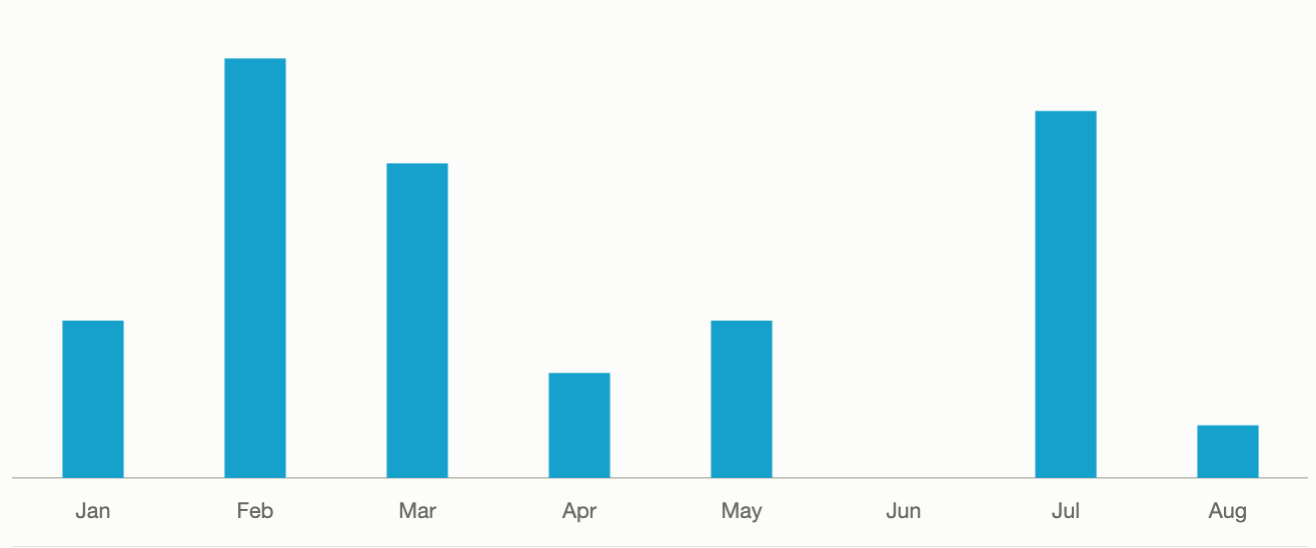
And filtered through the increasingly lucrative world of political content creation, that frustration with party leadership is becoming a force powerful enough to require figures like Beshear to adjust: His appearances in national media over the past month have notably ticked up to their highest levels since the winter.
Have fun indeed.
— Steve Morris
Writer + creator of The Long Run, host of Margin of Error
Got feedback on today’s newsletter? Email me steve@thelongrun.news
Grace, here 👋 No post Thursday. I hope you all take it as a nice time to get outside and decompress. I’ll be back with a heater on the 25th.