

Pope Leo enters the chat to swing at AI
I used to pray for times (and leaders) like this

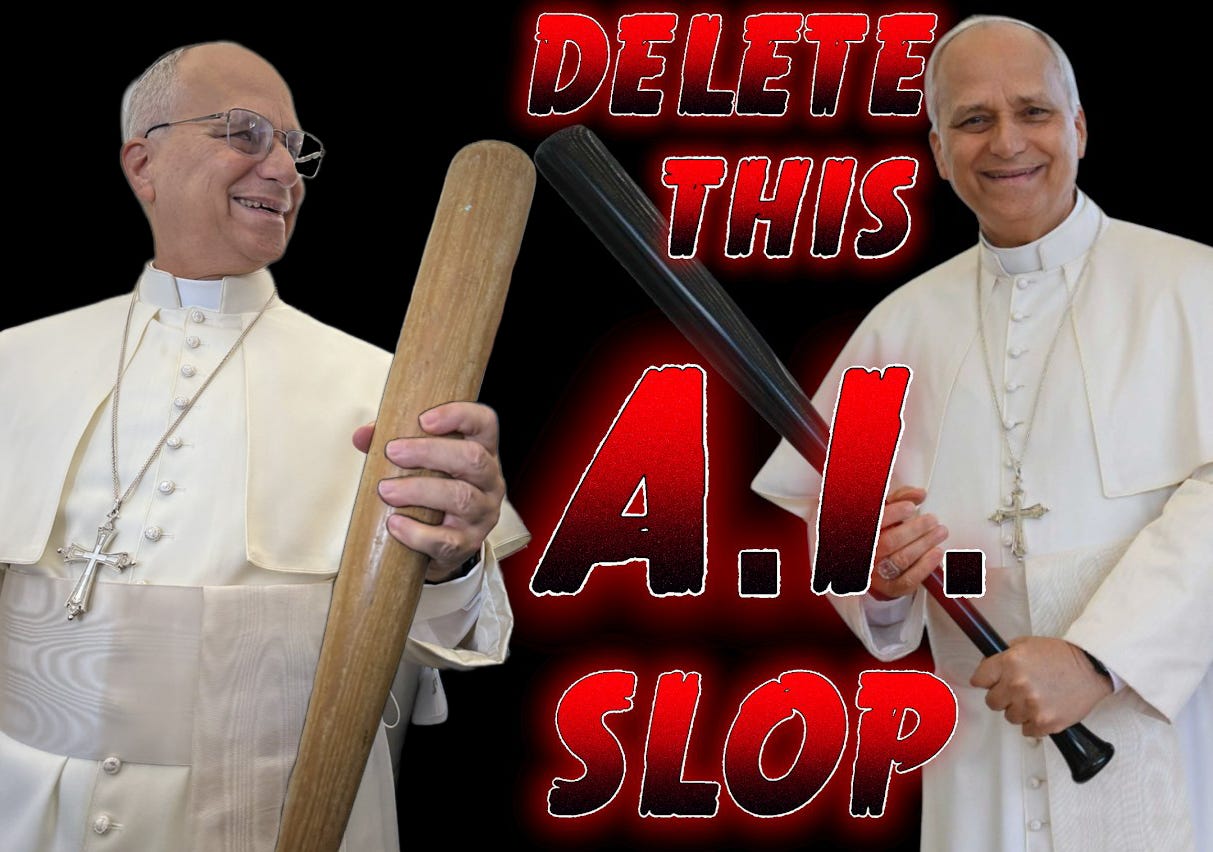
No, I don’t hate AI … but I haven’t done much in my professional or personal life to dispel the idea that I do.
Hatred is a strong word I try to avoid, largely because my antipathy is super conditional — I do see its value in fields like health and medicine. I have nodded my head and said “wow, that’s amazing” in response to peoples’ latest AI-assisted creations. I have, on occasion, meant it.
I’m certain I could benefit in some way or another from collaborating with an LLM to overcome lifelong personal disorganization. But here I am, utilizing what’s left of my anxious-avoidant tendencies to fend off AI’s insertion into my life at every juncture. A fool’s errand to you, vive la résistance to me.
As you can imagine, this is starting to cause a number of issues. I’m shocked by how far — and how quickly — my industry, my social circle, and our institutions have traveled from where I remain, feet cemented, in a shrinking community of skeptics and luddites. It feels a little lonely sometimes. The connection between me (a finder of joy in arduous process) and a heavy-user (a worshipper at the altar of optimization) can feel … incompatible.
But I love being challenged in this respect. I’m staring down the barrel of a four-hour AI training at work this week, where I will come curious, open-minded, ready to be convinced. I know it may shock you when I say that I am actually not the problem here — as wary of tech as I may be. I’m actually ready, willing, able to change my mind, but it takes more than just a good argument for me.
My frustration with AI, its acceleration, and our blind acceptance of both has more to do with the lack of critical, invasive, philosophical questioning than with its actual technology. We’ve seen total resignation to this new state of life. It’s come with very few demands that these companies prove why their systems deserve our blind trust, why their risks are worth the rewards, and why ceding certain freedoms to them is in our best interest, personally or nationally.
Because of this incuriosity, we (especially as workers) have accepted the default position of having to prove our worth, our value, and ourselves in AI’s world rather than the other way around, despite our tenure here on Earth. There’s something about this that feels distinctly un-American to me in a stand-your-ground, come-and-take-it type of country.
That’s why I’ve felt, deep in my non-believer’s spirit, that an eventual magnum opus warning of AI’s subjugation of man had to come from an American. On May 18, I saw a post that made me feel stupid af that I hadn’t considered the AMERICAN pope the obvious candidate for the job. I immediately felt even more stupid typing “what is an encyclical” into good ol’ fashioned Google.
Why this is actually a post about content creation, what the reaction has been to the papal release, which political group is missing a huge opportunity to lead on this subject, and how Catholicism is ascending in an unlikely demo … all below!

LEO LOGS ON
Before the Vatican even dropped Pope Leo XIV’s encyclical — kind of like a theological press release clarifying the Church’s view on a subject — I knew I’d want to write about it. That typically results in some clumsy shoehorning by yours truly to fit an unrelated topic into the already forgiving and expansive purview of this Substack.
Pope Leo did me a huge solid this time in helping this align with our regular programming. In his 42,000-word “MAGNIFICA HUMANITAS: On Safeguarding the Human Person in the Time of Artificial Intelligence,” he covers everything from algorithms (19) to disinformation, platforms (10), surveillance, technocracy, journalism, social media, politics (71), and even “the digital attention economy.”
But its cohesion is accompanied by the strangest feeling, recognizable without reading the encyclical in full (you should), just by seeing the list of terms above: We’re witnessing the steady hand of a leader with the digital fluency to not only diagnose an existential problem of our times, but to prescribe a way to heal it.
Some diagnoses from the chapter on “truth, work, and freedom”:
From 135: “The content that circulates within digital environments shapes how people perceive the world and introduces into the collective consciousness images and narratives that direct our desires and influence our daily choices. This is ‘not a parallel or purely virtual world,’ [145] since what originates online now becomes a part of people’s lives, especially of the youngest.”
From 136: “...those who control digital platforms and means of communication have a considerable ability to affect the collective imagination and to present a particular vision of reality as desirable. Such power should be constantly guided by the pursuit of truth and respect for human dignity, so that the culture fostered on the internet does not become an instrument of excessive distraction, homogenization or dominance …”
And some prescriptions:
From 137: “On the level of public policy, this entails establishing norms so that the decision-making behind content selection and its development becomes more transparent and protects personal data. Regarding social and cultural aspects, this requires a strengthening of intermediary organizations, serious journalism and forums for debate, where reasoned argumentation and verification carry greater weight than immediate reaction.”
From 142: “... Far-sighted public policies are needed to oppose the immediate interests of platforms, concentrated in a few hands, when they conflict with the wellbeing of minors. In this regard, interventions by legislators are appropriate for setting age limits, holding service providers accountable rather than shifting the whole burden of control onto families, and for providing specific protections against all forms of online sexual exploitation and violence. [...] it is also necessary to teach children, adolescents and young people how to recognize manipulation, defend their dignity and respect that of others in digital environments.”
This type of enlightened and urgent discussion feels so lost in our politics these days. I actually think two prominent Catholics got an early start on the homework he’d end up assigning in “reviving dialogue.” That’s not enough, though. Leo took a big swing here — how can we know if he made contact?
PREACH THE GOSPEL — IF NECESSARY, USE SOCIAL MEDIA
That digital fluency really begins and ends with distribution. If an encyclical is published, and no one is around to read it, does it make a sound? In the age of social media, no, it most certainly does not. The Vatican is not necessarily known for its cutting edge social media strategy, but some content just transcends what we know about the algorithm. In this case:
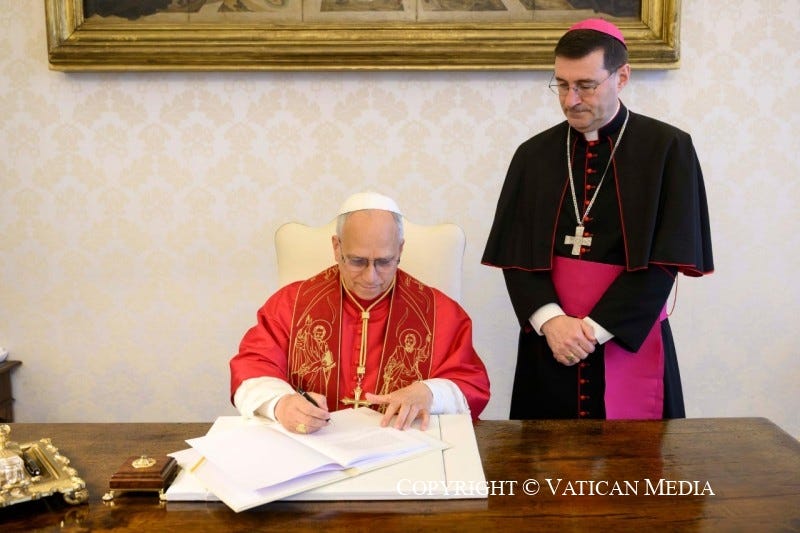
I opened Instagram to see that Pope Leo had posted an Instagram story. Is it out of the realm of possibility that he would be sharing the “SOX WIN” graphic to his story from their Memorial Day matchup? For now, yes. It was a series of custom slides promoting Magnifica Humanitas. His in-feed post was a humble two-slider of his signature on the publication.1
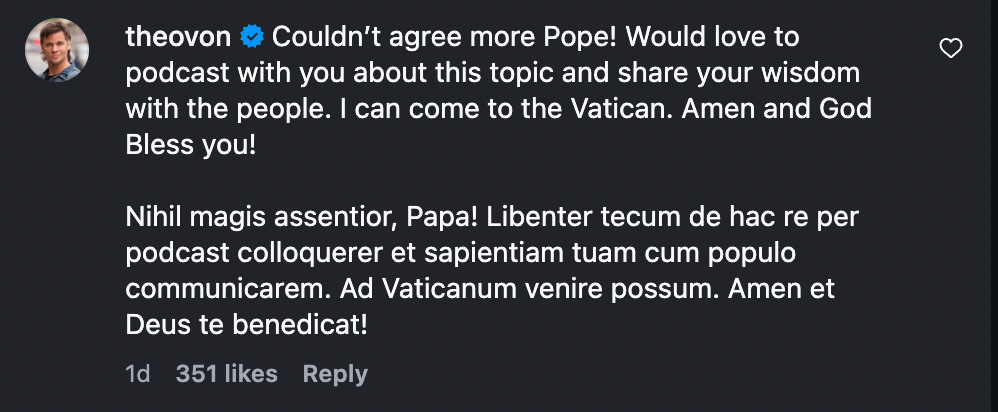
Reason number 5,712 I’ll never delete that app: Below the pope’s post is a comment from Supreme Podcaster Theo Von, inviting Supreme Pontiff Leo Vix onto his show. Theo kindly offers to come to the Vatican if it’s convenient, and he includes the Latin translation of his comment so nothing gets caught in the language barrier, American to American. (All that said, rooting for you, my g.)
This proved to me that a papal encyclical had broken containment and reached the target audience. There is an excitement around the pope in America and our claim to him — a desire to bask in his aura, receive his blessing, not even limited to those of his faith.
Reaction roundup:

The most viral post: “the pope wrote a 42,000 word manifesto declaring war on AI. we are so freaking back.” | 12.5M views, Georgia Coley
The biggest fact-check: DiscloseTV posted a clip of the p.ope and quoted him as saying he’ll “work with” Anthropic. He said “walk with,” and users made that correction in the community note. 5.5M views.
The clearest sign he’s right: The representative from Anthropic, Chris Olah, issued a genuine cry for help in addition to the acknowledgement that what “the Holy Father observes” is true:
“We need more of the world — religious communities, civil society, scholars, governments, and indeed all people of good will — to do what His Holiness has done here: to take this seriously, to look closely, and to push events in a better direction. We need informed critics who will tell the labs when we are failing. We need moral voices that the incentives cannot bend.”
PREDICTIVE TEXT
Two groups whose expansion or contraction will tell us a ton about their ability to capitalize on a profound philosophical/emotional/digital/political/theological opportunity like this:
1: The United States of America’s Congress — In a world where their collective reaction time was closer to Usain Bolt out of his blocks than a fat basset hound out of a nap, our elected officials would be rejoicing in the name of Jesus Christ for the gift Pope Leo has given them. They have all but announced their official disinterest in pursuing AI legislation at a grand scale. I presume most of them think they’ll simply die before it becomes a materially urgent threat requiring dramatic legislation. (In which case, the level of aggression can be restrained by the highest bidder.)
This encyclical provides them with a map so clear, it’ll tell them where to turn at every juncture. Too bad they’re still working off of paper directions from MapQuest.
2: Gen Z Caths — I have been obsessed with tracking the growth of Catholicism among young people over the past few months. And for that reason, I’m going to reserve my full gospel for a future piece (or conversation 👀). But the gist of it is, their key influencers on social media are elated over this publication.
Audrey Strobel: major force in making Catholicism cool again
Posted at least five reels about the encyclical2
Across the Pews: focuses on his “digital attention economy” bits and the “polarization of Christian content”
Multiple young creators specifically highlighted Leo’s work to detach your sense of self from your performance:
Aubrey Corrigan: “Your dignity existed before you did anything.”
Ana Munley: “Your dignity existed before your accomplishments did.”
Aesthetic posts, face-to-cams, and quote carousels proliferated instantly
Augustinians, like Pope Leo, are sharers — their vow of poverty rejects personal ownership in favor of sharing everything among the collective. I can imagine that’s the reason the word “common” appears 108 times in Leo’s encyclical, 82 of them attached to the word “good.” In accordance with his tradition, he’s sharing his personal antidote to the AI ailments we face as a society.
Thank God someone stepped up to do it.
LOOSE ENDS
📝 Word I learned today: homunculus
2: definition — “Pope Leo is taking shots at Peter Thiel while rebuking his homunculus lab experiment JD Vance and AI accelerationists in general” (via Pedro L. Gonzalez)
(Homonculus lab experiment is crazzyyyy lol)
📰 Something you should read today: cc Charlotte Alter

“At its core, AI is about eliminating inefficiencies; but what if our inefficiencies make us human? What if tolerating, even celebrating each others’ quirks and flaws and eccentricities isn’t weakness? What if that’s just part of being alive?”
🥹 Something to make you smile today: I took a page out of the big PL’s encyclical and didn’t mention a single government official by name in this whole piece. We all deserve a day off from their nonsense.
Looking at it, I realize for the first time that you have to find a new signature for your new name as pope. I wonder how many options he tried before he settled on a simple cursive Leo followed by a script “PP.” then XIV with a connected floor and ceiling.
Total number of reels she posted unclear due to her use of the “trial” reel feature that keeps videos off your profile.
You are not alone.
I love this. Congress…This encyclical provides them with a map so clear, it’ll tell them where to turn at every juncture. Too bad they’re still working off of paper directions from MapQuest.