

Exclusive: Ro Khanna isn’t afraid of making mistakes
“There’s almost nothing you can say in one of these podcasts that’s going to end your career.”

I got the text Friday at 11:44 a.m. — at noon, I hit record on an interview with Rep. Ro Khanna.
There’s something jazz-like about scheduling in the political world … something innately improvisational. No surprise there, considering creators and journalists (and the few of us media centaurs who are a blend of both) are reactive to the quick pivots of our lawmakers, who themselves are reactive to the volatile winds blowing out of the White House.
I once had 24 hours to report to Madison, Wisconsin, to interview President Biden. I nurtured spurts of possibility over the course of the 2024 DNC to get 10 minutes with PA Gov. Shapiro — got it done in eight. It’s all about walking the line between persistence and patience.
Khanna is one of the few legislators who has put in the hours to understand what content processes actually look like outside of just picking up a phone and filming. It’s why I went to D.C. for a day to hear him speak about a need for a “Creators’ Bill of Rights.” Can you imagine any other congressman saying that?
This is a major put-money-where-mouth-is operation, grounded in his refusal to adopt the surface-level language or trends of the viral world. He actively looks for ways to embed himself in the source code, and I have been dead set on deciphering some of that code for myself.
So, when Sean Hannity pulled rank on me (🙄) calling Khanna into the lion’s den on Thursday night, I locked into the journalism jazz mindset to be ready when he rang. And on Friday morning, he did.
16 minutes later, we were chopping it up on all things social: releasing the fear of getting it wrong, making videos to preserve truth, maneuvering Epstein and ICE messaging — and whether he’s planning to make the leap from guest to host.
*Interview has been lightly edited for length and clarity
GW: Just putting us in the context of this week: you finished an interview with Shawn Ryan, and that interview struck me [...] You are sitting down and giving time to a person that your base probably doesn’t like and doesn’t respect. So, you have to get over the fear of that. And part of the struggle of content creation is you have to get over the fear of saying something wrong and saying something that people don’t like. How have you worked through those two things to become this prolific content creator that you are?
RK: Yeah. Well, I have said a lot of things that are wrong and the reality is you face blowback for a day or two and then you move on. And you realize, if you’re going out to dinner with a friend, you have a conversation. Most people say things they regret or say things that are not precise. That’s real life. And we bandy around this word “authenticity,” but people don’t actually want to take the risk of being real.
Because when you’re real, you’ll make mistakes, you don’t always script your words. But I have found overall that when you do this, not only do people respect it and get over sort of a particular gaffe, they also end up helping you because you develop ideas and think about things you never did. And so to me, this is what we need more of in our democracy.
GW: Do you think that’s had a big effect on other congressmen around you who can see what you’re modeling? And it maybe rips the Band-Aid off and says, OK, I can also put myself out there and do this type of messaging as well.
RK: I think it’s having an impact. The biggest thing I say is don’t be afraid of making a mistake. It’s not the end of the world. There’s almost nothing you can say in one of these podcasts that’s going to end your career. The other thing I say is it takes a lot of time. It takes effort. But it’s part of our job.
It’s no longer enough to just go vote and be on committee and do the policy work. You have to be out there communicating and listening, because if you’re not doing that, nothing you’re doing is actually making an impact with people. And I think that people are understanding that. It’d be like being a congressperson never doing a town hall. The modern means of communication has changed and people have to change with it.
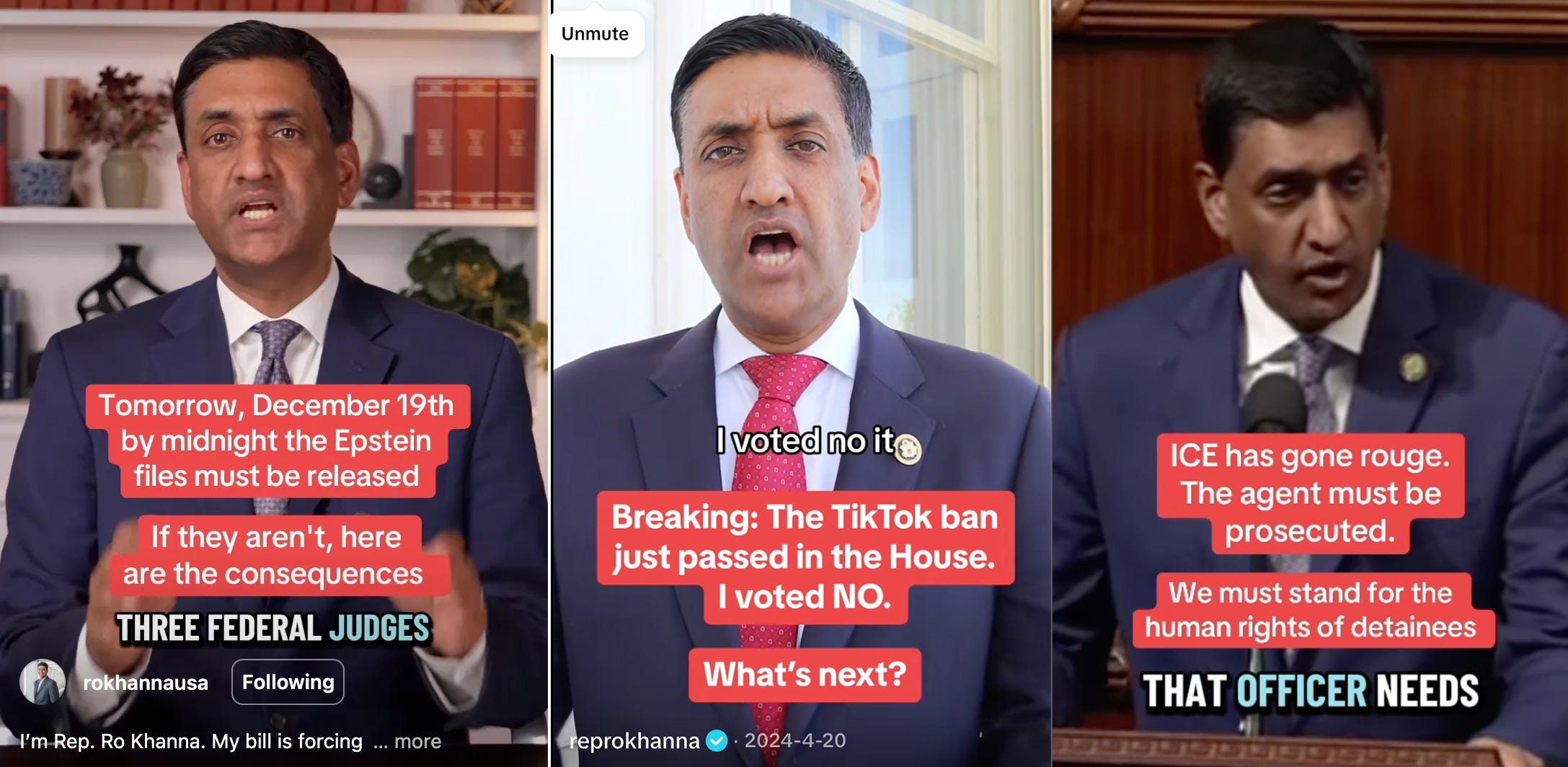
GW: The standards and accepted practices around these communications can be tricky when you’re trying to message something like the Epstein files. [...] And the Epstein files are chock full of information that’s NSFW. Has that been a struggle for you to figure out how to talk about it online from a platform perspective? Adding in the stonewalling that’s coming from the White House, how has that changed your attack and approach in messaging?
RK: It has been a challenge. I have tried to articulate what the survivors have told me, but there have been times, candidly, survivors will say, “Oh Ro, I would have worded that differently.” [...] So I take a lot of feedback from the survivors, the survivors’ lawyers, in how to speak about it.
Because it’s something that’s still creating trauma for so many people. One survivor described it as having a box and putting that box away, but the box keeps coming back at different moments. And I’ve seen the emotional toll that it’s taken on them.
In terms of the communication of Pam Bondi, just hiding things and covering up, that’s been pretty simple. I mean, she’s not complying with the law. They keep hoping it goes away. It doesn’t. Just today, Pam Bondi basically pleaded with the judge saying, “no, no, no, we are trying. We are getting these files out.”
Massie and I intervened in this case. I’m hopeful the Southern District of New York will order the files that we all want to see out. I’m confident we will get the files, but it’s been much, much, much more of a fight than it should have been.
GW: And I’d imagine that’s a bit challenging when the opposing team that you’re fighting against is very well-versed in the attention economy. They understand the power of attention, how to manipulate it and use it as a distraction.
