Division dominated CPAC: Who will reap the rewards?
I sat down with a young, ascendant influencer on the right to see how he's making his move.

You’re here because you’re watching politics get body-slammed by digital culture and content creators. I’m here because I’m the only one who can guide you through it.
At 3:48pm on Friday, half of the main stage audience at CPAC was empty.
A lot of the coverage of the conservative convention up to this point focused on empty seats — but much of that was misleading, sharing snapshots taken before most attendees arrived. By mid-afternoon, the hall looked and felt full, despite the audience’s apparent participation in Beyoncé’s Mute Challenge.
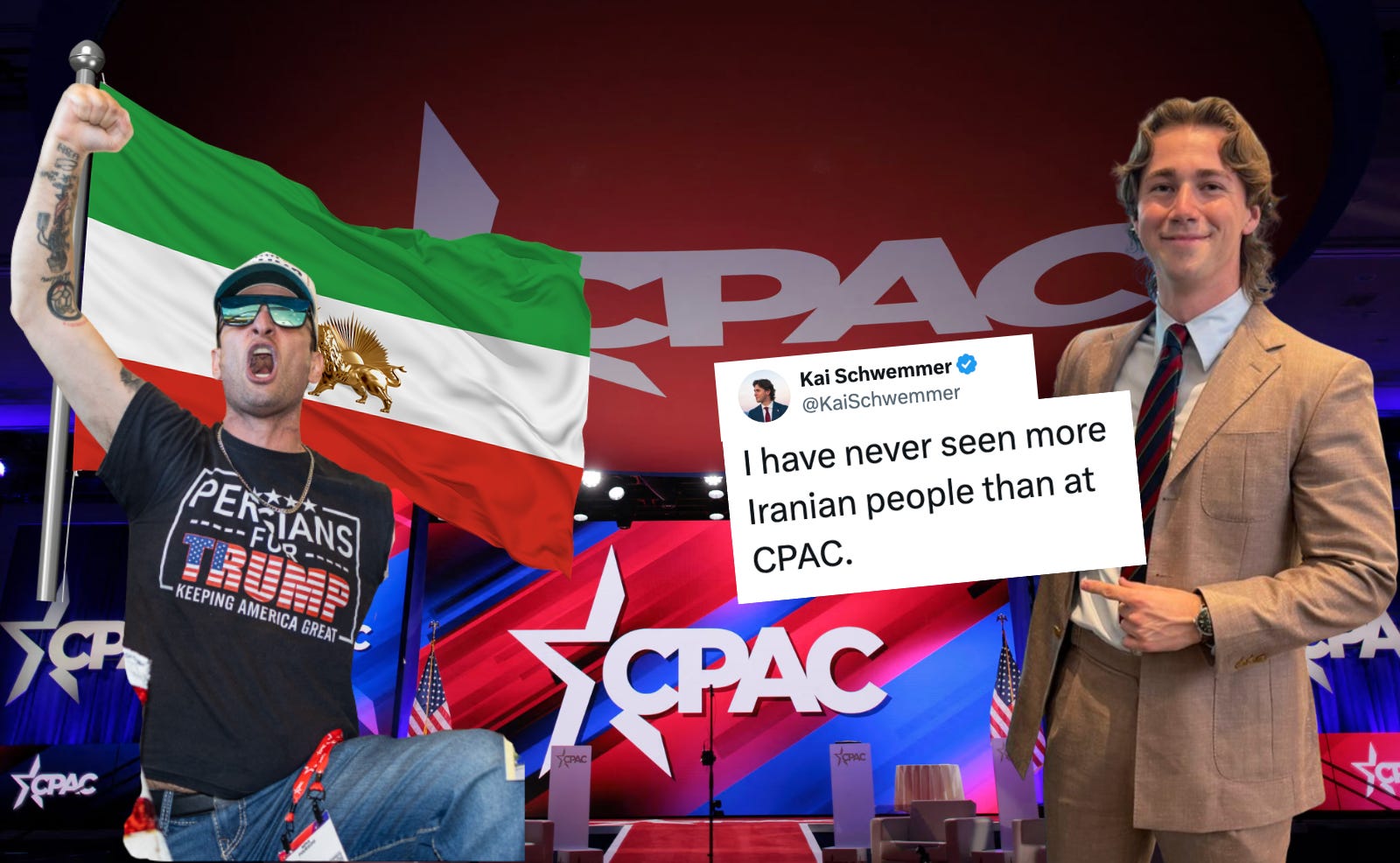
The truly manic exodus occurred during the “Prison Break” panel, moderated by CPAC Chairman (accused of groping multiple men) Matt Schlapp and featuring notable recipients of Trump pardons. Someone with a heavy security detail traversed the venue heading toward the exit. It became clear when every attendee sporting a “Lion and Sun” Iranian flag launched out of their seats that the passerby had to be exiled monarch, Reza Pahlavi.
The exuberant hallway chants of “Javid Shah” — “long live the king” — quickly drowned out the panel, mic’d up and all. The faces of the mostly 55 and up white people around me ranged from mildly annoyed … to genuinely confused … to outright terrified.
Those left in the room were in the throes of a collective realization: the Trump 2024 tent might be a little too big for their liking. The MAGA vs. MIGA representation broke heavily in the latter’s favor. More Iranian flags than American, more Pahlavi photos than Trump — disconnection between CPAC expectations and reality.
“Weird” was a descriptor everyone I spoke to at CPAC agreed on. A defining quality of that weirdness had to do with the makeup of the audience: A majority of people were first-time attendees and a majority of long-time CPAC staples (like, uh, the president) simply didn’t show. So, to testify to the potent weirdness smothering the entire GOP, I knew I needed to find someone representative of a demographic they risk losing in a midterm year.
The options abound, but Who Broke It focuses on the characters who artfully identify divisions to exploit online, mobilizing people offline as a result. I refined my search ahead of my trip to Dallas in order to target someone young, ascendant, and hard to box in. That brought me to 23-year-old Kai Schwemmer, less than a month into his tenure as political director of the College Republicans of America, who granted me a 30-minute audience on the final day of the conference.
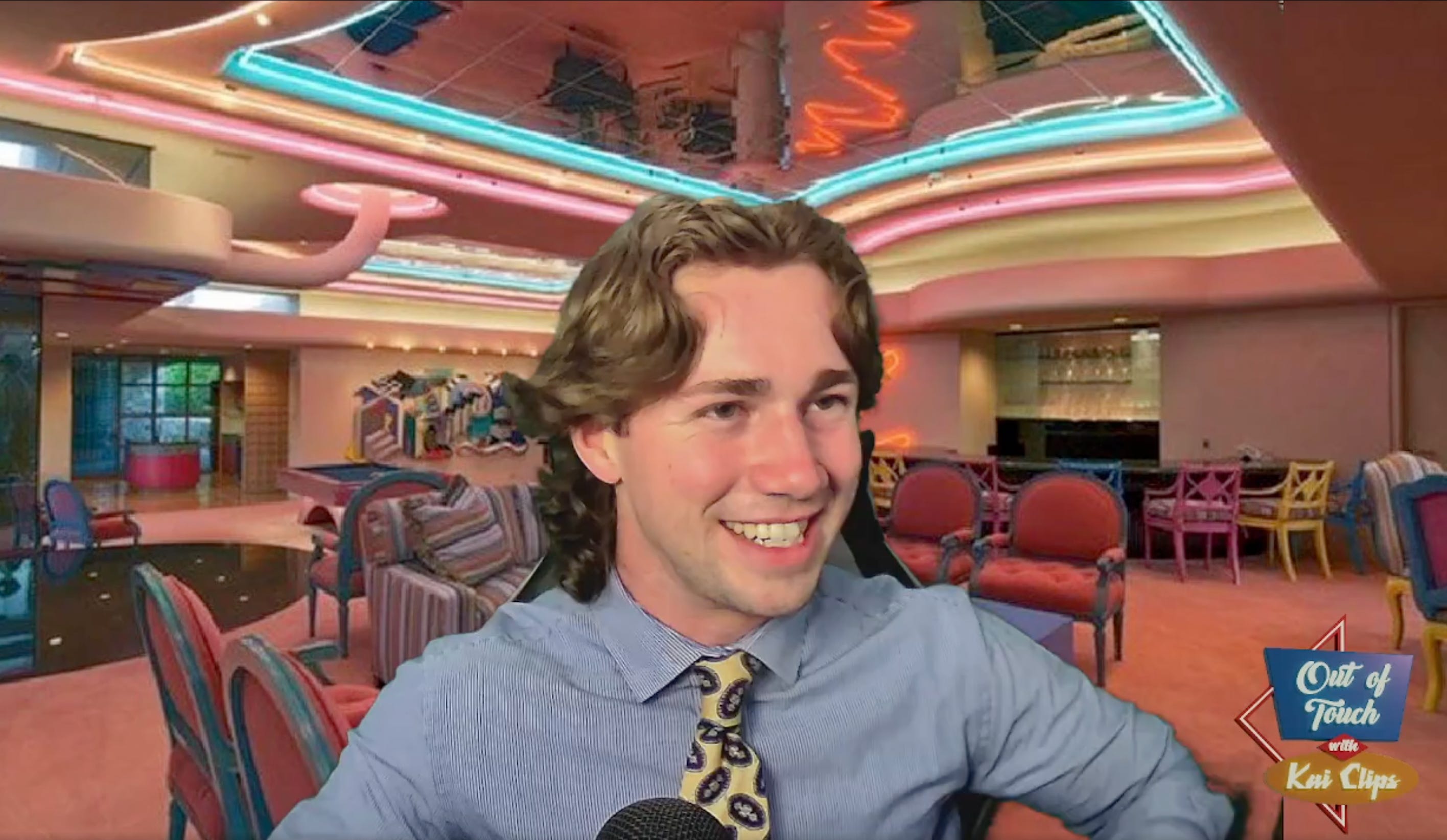
The self-described American nationalist meets my target criteria: garnering more and more attention (and criticism) online. He’s undergoing somewhat of a rebrand — ditching a rather Berries and Cream haircut for a modern mullet and making a somewhat flaccid attempt to distance himself from the most inflammatory of his views.
Here’s the thing about Kai, he’s extremely happy — a far cry from the troll under a bridge vibes Nick Fuentes brings to the function. The words he uses over and over again? “Chipper” and “jovial.” Being unhappy? It’s “unconstructive” and “not a preferable outcome,” he says. “It’s what Satan loves.”
“It’s very disarming to people. And I take a lot of, you know, pleasure in that. I love being able to talk to people and having them kind of be surprised at how cordial and kind I am. And it’s also a very effective tool [...] it’s very easy to look at a guy who’s just happy and smiling and carefree, and realize, you know, maybe this guy is not, like, some kind of neo-Nazi.”
For the record, I hadn’t brought up neo-Nazi allegations. He invoked the term himself. Word-for-word, this is what I said in response: “I think there would be a lot of people who would maybe look at, or listen to, what you just said, and then look at some of your beliefs or things that you promote and say like … ok, maybe that smile is a cover for more sinister beliefs.”
He follows by articulating that he understands not everything in politics can be tackled with a smile, offering mass deportations as an example. But framing policy “out of a love for nation” as opposed to out of “spite or hate for other people” is the goal, even if it comes across as “cover[ing] up a more dark desire to shape the country the way we see fit.” It’s all love, he declares.
I think he’s telling the truth about that. I think he absolutely, to his core, believes that his advocacy is rooted in love of country. But what we believe about our motivations isn’t always true. The reality of our impact plays an outsized role in determining the purity of our intent. As I sat down to write this, The Guardian published this about Kai: “College Republicans director made racist and sexist remarks on live streams.” True.


What you practice (bigotry) and what you preach (love) can be fundamentally misaligned. Kai’s content and views, even if they’re old or disavowed, exist as a sign that his self-conception is likely different from the public perception of him. People on the left love to call this out in Republicans who have two feet planted on biblical grounds.
And those theology-minded members of the right love to hit back. Martin Bertao, the president of the CRA, tells me he thinks “right-wing Christians should do more to kind of correct the narrative there, rather than just letting the left try to take this broad — like that Christianity is just like love and rainbows.”
Kai, who is Mormon, adds: “There are plenty of atheists who would happily quote verses of scripture whenever it is most profitable to them, removing them entirely from their context, and without any kind of concern for what Jesus actually requires of us, which is serious discipleship and sacrifice.”

That very discipleship and sacrifice can be at odds with victory in electoral politics. I see him trying to work that out in real time. Like how to square Trump’s “OnlyFarms” initiative with the speech he had just given about the destructive nature of pornography. (Both CRA reps agree they’re more concerned with what the website does than with what it’s called.)
When we move to the topic of midterms, Kai worries that the party has “lost touch” with just how revolutionary it was putting Trump, who was “never a viable candidate,” in office. Five minutes later, I ask if the very viral James Fishback has the sauce to make it to the Florida governor’s mansion. He said he’s been a fan of the campaign, but there are certain “poison pills” that spell doom.
“I think the abortion issue alone — not to go back on what I just said about viability — but, you know, the elections have shown us that Democrats just turn out so radically on that issue alone … it’s super difficult.”
Kai’s midterm outlook is “not great.” I question whether the “MAGA civil war” played a role. Marty assures me that beef is “just amongst podcasters … The base is not sitting here attacking each other personally.” He’s also more optimistic, thinking the worst case scenario is something akin to 2018 (still pretty bloody fwiw). Kai wishes the party dedicated more focus to policy, less to “cultural issues.”
I add, in an unbelievably eloquent fashion: “So, policy, like, at its core, is just, like, not sexy.” I’m like Cicero with an iPhone, everyone is saying it. I wanted to know how he — as someone putting a lot of time into producing more content — plans to make policy not just relevant, but attractive.
The most common answer I get to this question is also the most divisive: debate. He grew up watching Steven Crowder’s faceoffs with college students and Ben Shapiro’s speeches that focused on hard policy, not just culture war issues. His vision is this:
“If you have good orators who are able to debate issues in logical ways that prescribe policy for the party, I think that’s how you do it. … You just need a sexy person to say it, right?”
LOOSE ENDS
📝 Word I learned today: fissiparous
tending to break or split up into parts : divisive — “the highly fissiparous nature of the Iran War with Trump’s young male base” (via Charlie Sabgir, a note on his feature in The Atlantic)
📰 Something you should read today: I Got the Tucker Carlson Merch. I Don’t Think He’d Like My Friends’ Reactions. — Luke Winkie
*Grace note: I fuckin’ told you so!!!
“I bought two hats—the world-renowned NYC cap and a black snapback that smugly proclaims, “I Heart Conspiracies.” The goal was to wear both of them around my neighborhood, in central Brooklyn, to test my theory. Did Carlson indeed produce a clothing brand that is fully in line with the aesthetic signifiers of the Mamdani coalition? Would his hat meld with the lefty scenery in a way a MAGA cap could never? Would I get compliments? And if so, does that mean that for the first time in recent history, conservatism has produced something fashionable?”
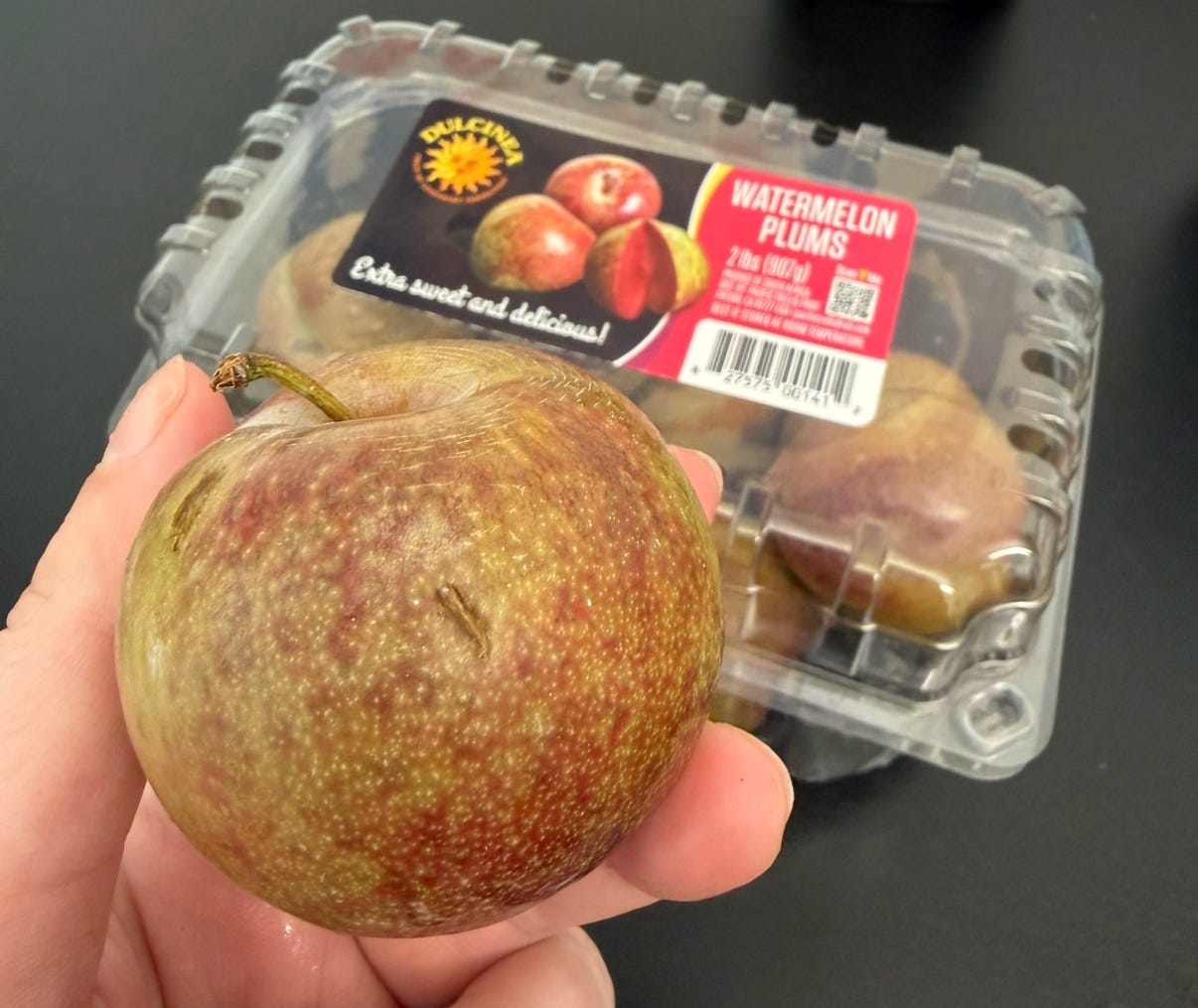
🥹 Something to make you smile today: I subconsciously started doing this thing where whenever I see a fruit I’ve never seen before at the grocery store, I buy it and bring it to my office and demand everyone try it. This is the THIRD iteration of plum I’ve put in front of them — cherry plums, golden plums, now these. And I’m beginning to wonder if we’re perhaps innovating too much in the stone fruit space. Feels Icarian if you ask me.